Constable: The cornfield
Landscapes at human scale
This month, we give thanks for the life and work of John Constable, born 250 years ago on 11 June 1776. How is it that the art of a man born in the happy days when Britain still ruled America should continue to exercise such a hold over our imaginations?
The cornfield, which also has a big birthday this year, can point us to several answers. Constable painted it in a rush for the 1826 Royal Academy exhibition after his plans to exhibit The opening of Waterloo Bridge ran into trouble. He took a sketch, now known as A cornfield, that he had made about ten years earlier in Suffolk and developed into this finished work.[1]
Like so many of his works, its subject-matter is from the everyday: an unremarkable country lane, which he used to walk down as a boy on his way from East Bergholt to school in Dedham. The boy in the painting, leaving his sheep for a moment while drinking from the stream, may well be a memory of the painter’s youth, as well as providing the magical splash of red to catch the eye among the sea of greens.
Constable has been accused at times of escapism, pursuing a lost idyll and neglecting the harsh realities of the industrial age. But he was what we have learned recently to call a ‘radical conservative’. Like a number of so-called avant-garde artists he was socially and politically reactionary,[2] a high-church Tory who deplored the Great Reform Act of 1832. Although modern-day Hegelians would say this puts him on the so-called ‘wrong side of history’, he had good reason for his conservativism: that great example of political innovation, the French Revolution, had been a salutary warning to many radicals, such as Wordsworth, who like Constable sought a different kind of hope in a deep engagement with the realities of the natural world.
I suspect that one element of Constable’s continuing power is that he really is a man on a mission. Although he sketches in his native Suffolk, he produces and exhibits his finished work in London. He is not hiding from present realities, but vigorously promoting a vision to mitigate and redirect them. And to do this, he develops a new approach to landscape.
He eschews the romantic taste for the sublime, which takes a kind of pleasure in humanity’s insignificance in the face of overwhelming and pitiless nature. Instead, he celebrates the human-scale landscapes of Suffolk, where we feel valued, significant, and safe.
But, highly critical of the formulaic approach to landscape which afflicted much painting of the time, he wanted to develop a way to convey the feeling (his word) of nature, hence his devotion to open-air sketching. In the twentieth century, under the influence of Impressionism, it was often claimed that these sketches from nature were his ‘real’ paintings and that the finished ones for the Academy were a necessary evil. But Constable never intended these sketches for public exhibition, and they were generally not sold until after his death. But, as with the sketch which preceded the finished painting The cornfield,they were a vital part of Constable’s looking, getting a feel for the landscape, which would then inform his finished work.
His emphasis on looking undercuts the accusation of escapism. In the spirit of Ruisdael, whom Constable admired, there are plenty of indications of death and decay: a pile of overgrown debris in the front left corner, a dead tree above it, a gate off its hinges in the centre, dark clouds overhead. The images are not of Eden, but a vision of a humane landscape that is there to be found if we choose to look carefully.
But Constable’s emphasis on personal experience, being present and looking, is only part of the story. As David Thistlethwaite observes, Constable understands that looking is a moral action.[3] We may all look at the same scene but we see different things, depending on what we choose to focus on and how we choose to interpret it, according to our preconceptions and beliefs. Whereas Wordsworth contemplating nature veered off towards pantheism, Constable always understood it as the creation of God our Father, and therefore something given, to be received with humility and awe and love.
Therefore, what Constable paints is not only what he sees but what he understands. And so his original experience in the sketch is woven into something greater in the finished painting. For although a Constable can look as though he just sat down and painted what was in front of him, that is far from the case. Nature does not present itself to us in tidy, frameable compositions. Constable’s paintings are constructed, so that what he sees in nature is encapsulated in something that is in itself thoughtful and beautiful, a painting composed to treat the subject with honour, admiration and awe.
Just to give one example, Constable’s compositions are usually not centralised, but are a balance of unequal parts, often framed by the Golden Section. The Golden Section is a specific set of proportions, recognised since the ancient Greeks as rendering a relationship that is particularly harmonious. It can be calculated by maths or geometry, and some artists, such as Vermeer, seem to have used it programmatically. But other artists, including Constable I think, seem to veer towards it naturally. The annotated images here show how the horizon line lies exactly on one of the horizontal Golden Sections; and the vertical Golden Section divisions not only locate the dog and balance the space of the boy on the left and the sheep on the right, but also highlights how the two clumps of trees, major players in the scene, respond to one another, unequally but harmoniously.[4]
At the same time, wanting to underline the essentially sacred nature of the landscape, Constable is not averse to moving a church tower to make it visible in the composition, and here it too sits on a Golden Section.
Made in an age when social reform was often identified with deism or atheism, his painting, focused on the lived experience of nature, treating it as the gift of our Creator God, and thus having meaning, and deserving awe, respect and love, was a kind of revolution, and it still speaks powerfully to us today.
BRIEF BIOGRAPHY
John Constable (1776-1837) was born in East Bergholt, Essex, the fourth child of a prosperous mill-owner and coal merchant. He studied at the Royal Academy Schools in London from 1799 to 1802, following the usual curriculum of drawing from life and the antique, and copying Old Masters, especially Claude and Poussin. But he returned to Suffolk in 1802, intent on pursuing a kind of landscape painting that he felt would be more true to real-life experience of nature.
He exhibited regularly at the Royal Academy, where he was elected as an Associate in 1819, but he struggled for further professional acceptance. In an apparent bid to raise his profile he submitted to the Royal Academy from 1819 to 1825 a series of large paintings, which he called his ‘six-footers’, showing working life on the banks of the Stour – watermills, fords, boatbuilding, barges - the reasoning being that smaller paintings were more easily ‘skied’ (hung high towards the ceiling), whereas large paintings were more likely to be hung at eye-level.
He achieved considerable success in Paris, where The hay wain won the Salon’s Gold Medal in 1824. It was greatly admired by Delacroix, and the French state tried unsuccessfully to buy it. But Constable struggled for acceptance at home, and was only admitted to the Royal Academy in 1829. Even so, he continued to be criticised for his brash colouring and an application of paint that was hard to read close up.
However, even his critics acknowledged the power of his work, and on his untimely death in 1837 a consortium of admirers, including Wordsworth, bought The cornfield and presented it to the collection of the recently founded National Gallery, where it now hangs alongside The hay wain.
Notes
[1] The sketch is in the Tate Gallery (c. 1817; oil on canvas, 61.3 x 51 cm). See Constable: the great landscapes, exhibition catalogue (London: Tate Publishing, 2006), p. 116.
[2] For other examples, see Peter Fuller: Theoria: art, and the absence of grace (1988), p. 175.
[3] David Thistlethwaite: Re-digging art’s foundations (Eugene, OR: Wipf and Stock, 2024), ch. 4.
[4] The Golden Section is the division of a line (or space) into two unequal parts such that the ratio of the smaller to the larger is the same as the ratio of the larger to the whole. For more information see Mario Livio, The Golden Ratio: the story of phi, the extraordinary number of nature, art and beauty (2003) and Charles Bouleau, The painter’s secret geometry: a study of composition in art (2014).
[First published by ArtWay, 21 June 2026]
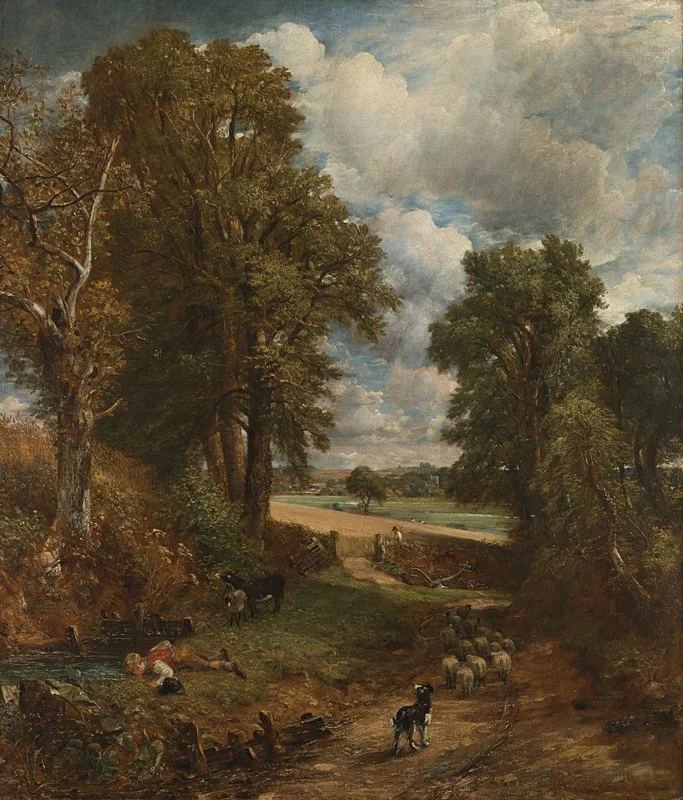
John Constable (1776-1837): The cornfield (1826; oil on canvas, 143 x 122 cm; London: National Gallery)
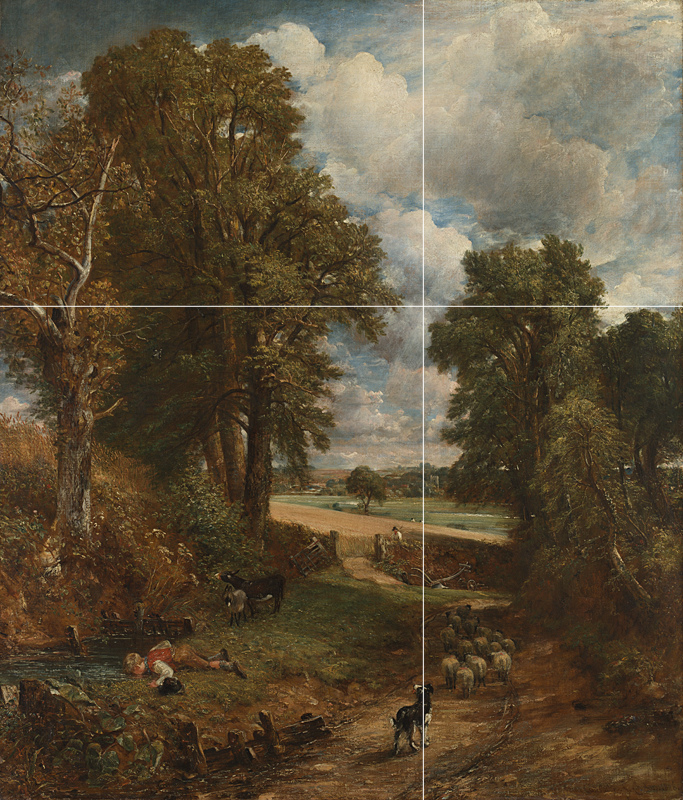
The cornfield with lines of the Golden Section added
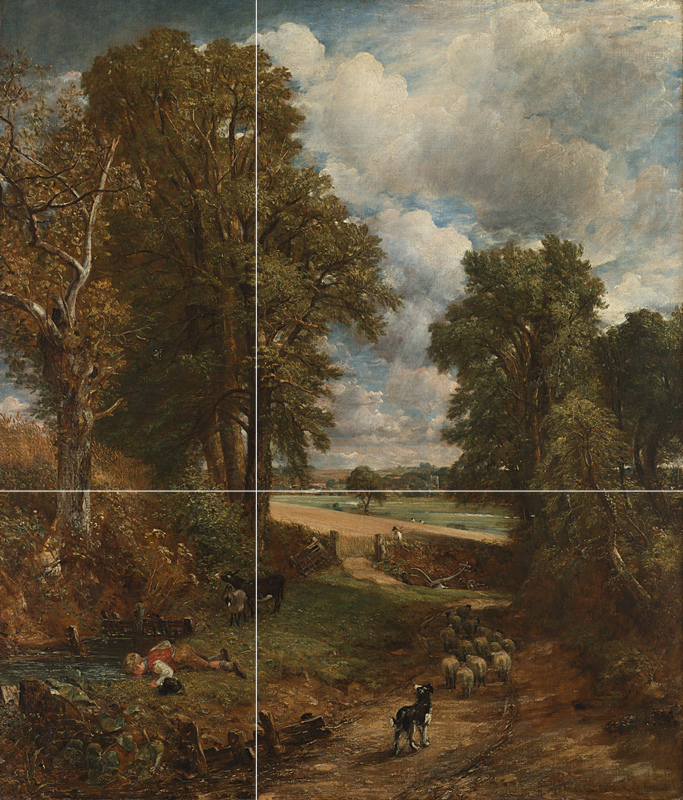
The cornfield with lines of the Golden Section added