Constable: The hay wain
Scientific and emotional, material and spiritual
In a time of political and social upheaval what, along with cream teas and warm beer, could be more comfortingly and quintessentially English than Constable’s Haywain? Willy Lott’s ancient cottage stands unchanged on the left. The cart turns slowly through the ford; the boy points ahead, perhaps encouraging the dog to come with them. The man on the bank is still patiently fishing, while in the middle distance in the dappled sunlight the harvest is being gathered. In that direction of travel, from the turning cart to the sunlit harvesters and the horizon beyond, is a movement from shadow to blue sky, from here to a hopeful but not unrealistic future.
In such an iconic image of peace there are a surprising number of apparent contradictions in play. Perhaps it is the very balancing of these that creates this aura of comfort and hope.
Firstly, this image of serenity was dashed off in unusually short order for the 1821 Royal Academy exhibition. Constable took the advice of his friend Joseph Farington to postpone plans for a painting of the opening of the new Waterloo Bridge (a painting that would not be finished for another decade), and knock off another rural idyll to capitalise on the success of his Stratford Mill at the Academy the previous year.
Secondly, this painstakingly detailed depiction of rural Suffolk was painted in central London, using sketches Constable had made over the previous ten years (the dog had been on that river bank since at least 1811!) Constable is looking back to his idyllic childhood, which is perhaps why it so easily suits a nostalgic reading.
For thirdly, this English idyll is painted at a time when Constable feared, with good reason, that it was under threat. With rural poverty, urban unrest (the ‘Peterloo’ massacre of workers in Manchester had taken place less than two years previously) and the reformist politics of the Whigs, terrible memories of the French Revolution haunted Constable, who was deeply committed to King and Church.
But then Constable himself is often seen as a contradiction. He was a political conservative, dead-set against Reform which had its roots in the Enlightenment. But he painted in a culturally revolutionary manner apparently straight out of the Enlightenment, rejecting the dead hand of tradition and insisting on painting from nature with quasi-scientific accuracy. This was exemplified in his unprecedented cloud studies, carried out in the same period as the Haywain. This air of precision is indicated by the original title of this work, Landscape: noon, half a century before Monet titled his paintings of haystacks and of Rouen Cathedral by the time of day.
And yet perhaps this contradiction in Constable is overstated. For whereas the Enlightenment drove a wedge between reason and feeling, between public truth and private opinion, between material and spiritual, Constable held them together. This is brought home in two of his most famous quotations. In a letter to his friend John Fisher he commented that ‘painting was but another word for feeling’; and yet a decade later in his lectures at the Royal Institute in 1836 he declared that ‘Painting is a science, and should be pursued as an inquiry into the laws of nature. Why then may not landscape painting be considered as a branch of natural philosophy, of which pictures are but the experiments?’
The hay wain blends scientific observation with nostalgic emotion, realism with idealism. The precision of the observation speaks of love – the kind of attention to detail you give as you gaze into the face of your beloved. Yet there is a subtle but firm artistic hand at work, laying out and adjusting the scene. The long straight line where the meadow meets the trees lies directly on the Golden Section; as does the vertical line through the boy on the haywain and the tree above him. These unobtrusive instruments help to give the everyday landscape that same air of perfection that we associate with a Vermeer interior.
Key to Constable’s ability to fuse the scientific and the emotional, the material and the spiritual, is that, as a Christian, he sees meaning in nature. One of the dangers of Enlightenment-driven secularism, apparent even in Constable’s day, was that nature lost its meaning: if there is no Creator, there is just stuff. And if there is just stuff, there ceases to be grounds for beauty. As we see in the works of Constable’s contemporary Turner, beauty is at best replaced by the sublime, a sense of awe and dread at one’s insignificance.
As is evident from his voluminous correspondence with his friends in the Church, Constable, in the Christian tradition, sees Nature as the work of God: to admire and love nature is a fitting response to its and our Creator.
As we, in England, enter another lockdown, we are tempted towards comfort food, and Constable offers us some of the less fattening variety. Our world is overshadowed by change, some of it sudden, some of it deeply unwelcome. And yet there is always beauty to be enjoyed in the everyday creation around us; and this points us towards the Creator, in whom we find secure hope, for now and for the future.
[First published by ArtWay, 15 November 2020]
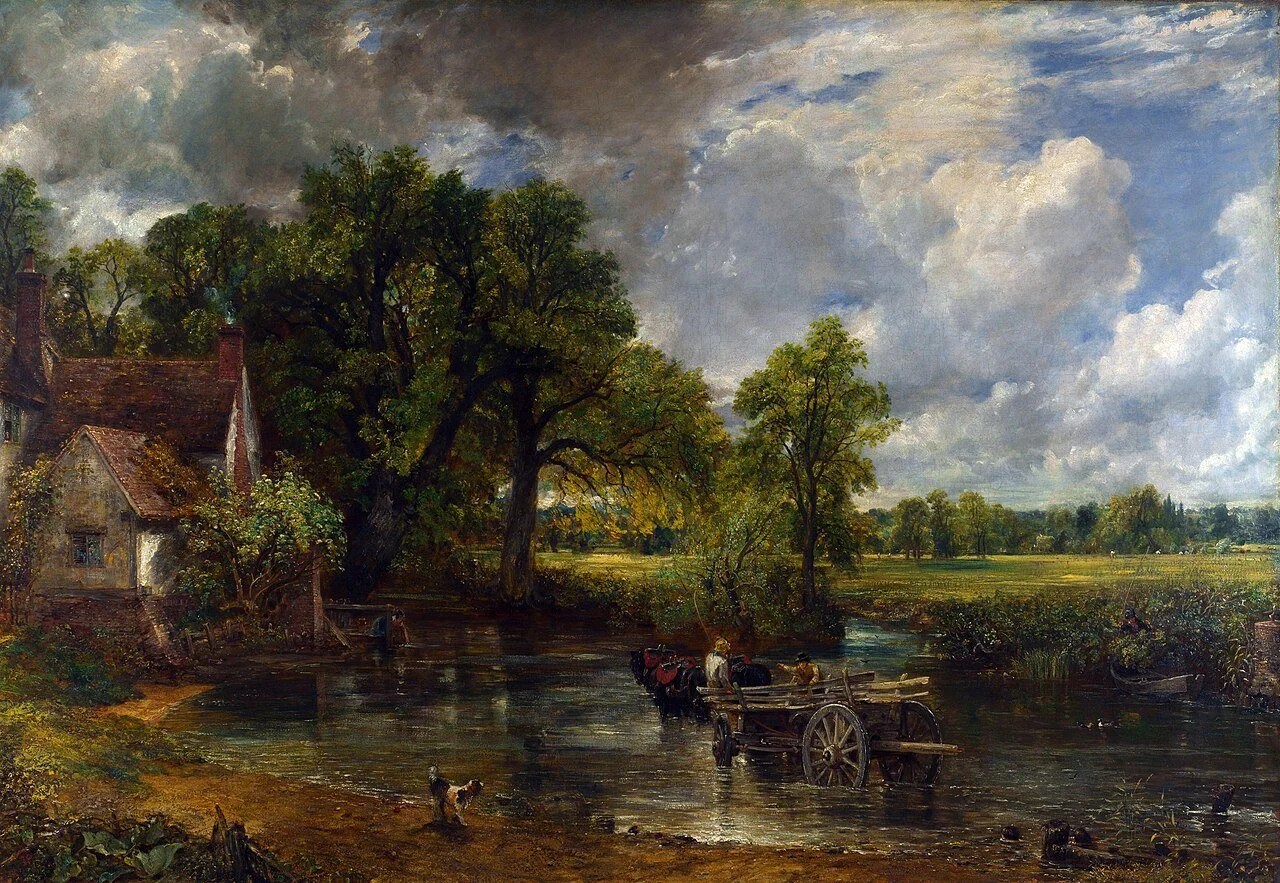
John Constable (1776-1837): The hay wain (1821; oil on canvas, 130.2 x 185.4 cm; London: National Gallery)