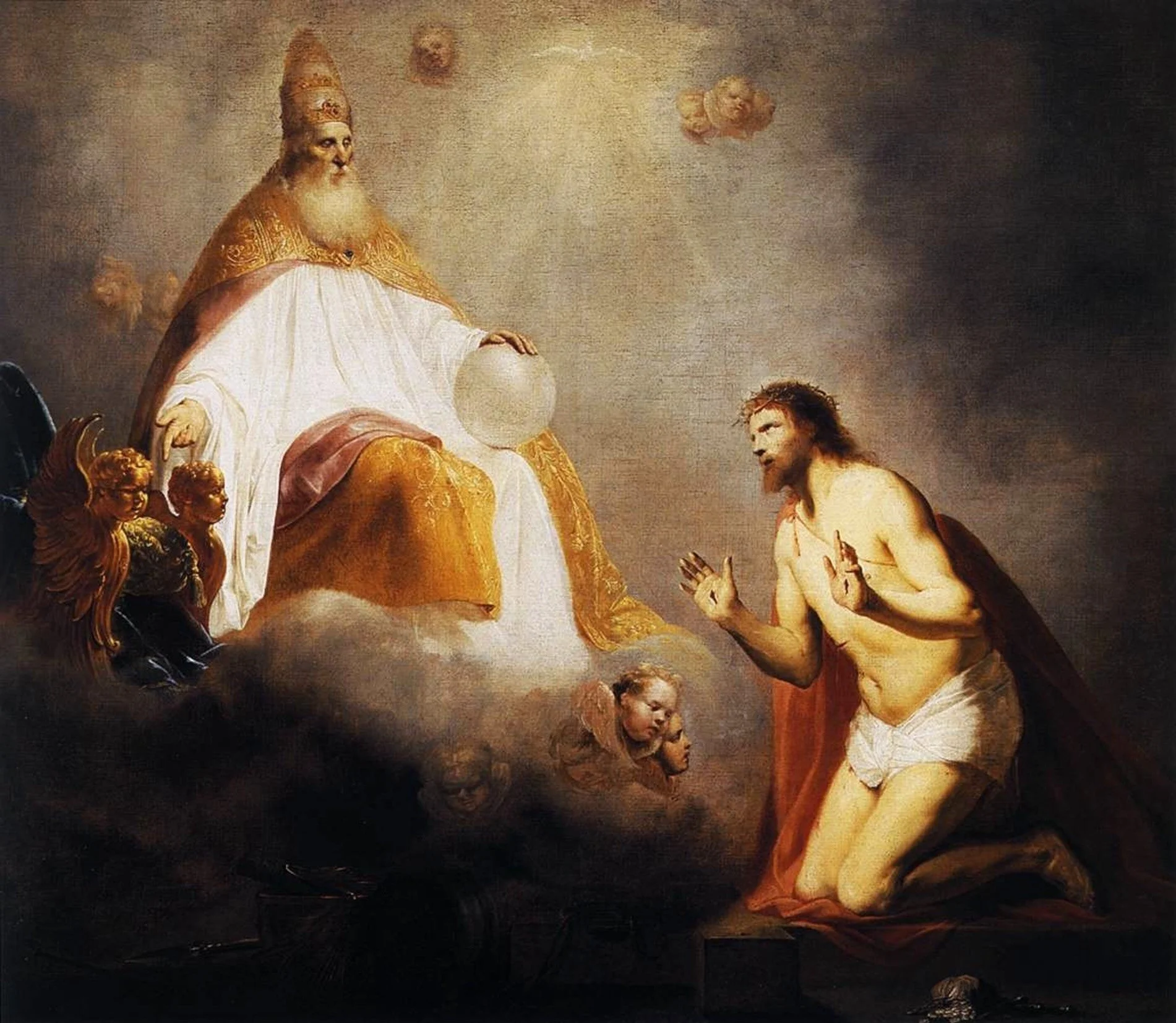
Pieter de Grebber: God inviting Jesus to sit at His right hand
Celebrating the ascension
Ascension Day can come and go rather unnoticed, especially for those outside the established churches. Falling 40 days after Easter Sunday, Ascension Day is always therefore on a Thursday, when good non-conformists like myself are likely to be at work and not in church. Rather late in life I have begun to see what a shame this is. For Jesus’ ascension is an essential part of the story of our salvation, to be celebrated along with Christmas and Easter, as all the historic creeds emphasise. The Apostles’ Creed, for example, states:
He descended to the dead.
On the third day he rose again.
He ascended into heaven,
and is seated at the right hand of the Father.
He will come again to judge the living and the dead.
Karl Barth went so far as to say that the fact that Jesus is sitting at God’s right hand is ‘the first and the last thing that matters for our existence in time.’ He added: ‘Whatever prosperity or defeat may occur in our space, whatever may become and pass away, there is one constant, one thing that remains and continues, this sitting of Christ at the right hand of God the Father.’[1]
While there are many, many paintings of the Ascension, and many others of the Trinity seated together in heaven, there is none other like de Grebber’s painting shown here, focusing on the act by which the Father seats his Son at his right hand. The uniqueness of this portrayal is striking given that this invitation in Psalm 110:1
Sit at my right hand
until I make your enemies
a footstool for your feet.
is the most-quoted Old Testament verse in the New Testament. And the Letter to the Hebrews places considerable significance on the fact that Jesus, having completed his work as our High Priest, is now seated at God’s right hand (Hebrews 10:12). The Old Testament priests never sat down (there were no seats in the Temple) because their work was never done – and in any case, you do not sit in the presence of the king. But when Jesus had died for our sins and been raised again, he took his seat at God’s right hand, signifying both that his work as priest is complete – in himself he has made a single, complete and final sacrifice – and that he is himself king and ruler, sharing the dignity of God the Father.
De Grebber lived and worked in Haarlem through the first half of the seventeenth century. Born into a Roman Catholic family in what became the rigorously Protestant country of Holland, much of his religious work was for Catholic congregations that continued to meet in secret. De Grebber nevertheless enjoyed a successful career, becoming a leading artist in what is now known as Dutch Classicism.[2] He received several commissions from the Dutch royal family, and painted several church altarpieces. The intended location for this particular painting is not known, but from its size and nature it was presumably intended for an underground church.
Paintings of the ascended Jesus often show him already enthroned beside the Father. But here de Grebber depicts Jesus humbly on his knees before the Father, indicating his continuing obedience to the Father’s wishes. Jesus still wears the crown of thorns, and the instruments of the Passion are displayed across the front of the painting. The marks of the crucifixion are seen on his hands, and the spear wound in his side.
De Grebber’s conceptualisation of this scene emphasises what an extraordinary ruler is about to take his throne in heaven: Christ in his humility and his obedience to the Father has descended to the earth to be the atonement sacrifice for our sin (Romans 3:25). And it is because of his humble obedience that he is judged worthy to take his seat at God’s right hand. The Lord’s authority is real and is exercised rigorously, but in God’s kingdom authority is always to be used for the good of those over whom authority is exercised. And in this painting, authority – indicated by Jesus’ being seated at God’s right hand – is the reward for Jesus’ self-giving for the good of his people.
There is, however, one problem with this painting, which is common to almost every painting of the ascended Christ. Besides de Grebber’s decision to dress God the Father as the pope, complete with papal tiara and vestments, which seems to be an over-egging of Catholic dogma, the problem lies in the decision to present the Father to us in human form at all.
‘God is not a man’ (Numbers 23:19), and to portray the Father here as a man detracts from the wonder that should accompany our discussion of the Ascension. For although God is not a man, yet through Jesus’ incarnation, death, resurrection and ascension there is now a man sitting in glory at the Father’s right hand. And it is into the hands of this man that all authority has been placed. And it is by this man that we will be welcomed or condemned when we appear before him.
At God’s right hand, right now, is one of us. The ascension of Jesus means that from day to day, in the very presence of the Father, exercising all authority across all creation, is one who knows what it is like to live our life, a high priest who is sympathetic to us in our struggles (Hebrews 4:15). And it also means that, far from being odd blips lost in the great and meaningless universe, human beings are so important that God the Son has become one and will remain one for all eternity, seated at the right hand of the Father.
In the words of an early Christian sermon, preached by Leo I (Leo the Great), Bishop of Rome from 440 to 461:
… in the sight of the heavenly multitudes, the nature of our human race ascended over the dignity of all heavenly creatures, to pass the angelic orders and to be raised beyond the heights of archangels… Today we are established not only as possessors of Paradise, but we have even penetrated the heights of the heavens in Christ… Those whom the violent enemy threw down from the happiness of our first dwelling, the Son of God has placed, incorporated within himself, at the right hand of the Father, the Son of God who lives and reigns with God the Father Almighty and with the Holy Spirit forever and ever. Amen.[3]
Notes
[1] Karl Barth, Dogmatics in Outline (SCM, 1960), p. 126.
[2] See Albert Blankert et al., Dutch Classicism in seventeenth-century painting, exh. cat. from the Museum Boijmans Van Beuningen, Rotterdam, 1999-2000 (Rotterdam: NAi Publishers, 2000)
[3] Basil the Great: Sermon 1 on the ascension. Cited at https://thepocketscroll.wordpress.com/tag/john-shelby-spong/ and https://www.newadvent.org/fathers/360373.htm
*******
Pieter de Grebber, God Inviting Christ to Sit on the Throne at His Right Hand (1645; oil on canvas, 115 x 133 cm; Utrecht: Museum Catharijnconvent).
Pieter de Grebber was born in Haarlem c.1600, the son of the history-painter and portraitist Frans Pietersz de Grebber (1572/3 – 1649). Pieter’s sister and a brother both became painters, and another brother became a goldsmith. Pieter initially studied with his father, met Rubens in 1618 through his father who worked as Rubens’ agent, and joined Haarlem’s guild of painters in 1632. De Grebber pursued a successful career as a painter, including several commissions for royal palaces and altarpieces for Flemish churches. His Rules to be followed by the good artist and draughtsman were published in 1649 and continued to exert a strong influence. He died in late 1652 or early 1653.
[First published by ArtWay, 10 May 2026]
Pieter de Grebber, God inviting Jesus to sit on the throne at His right hand (1645; oil on canvas, 115 x 133 cm; Utrecht: Museum Catharijnconvent).